The most restful work in ‘Amanat: The Sacred Forest’, an exhibition of recent films, photographs and installations by the Uzbek artist Saodat Ismailova at Luma in Arles, presents a series of figures asleep in the setting that gives the show its name. They are alone in Arslanbob, the world’s largest natural walnut forest, in the west of Kyrgyzstan. The only faint sounds are from leaves rustled by the breeze or trampled by animals we cannot see and a film-maker who largely succeeds in making us forget that she is there.
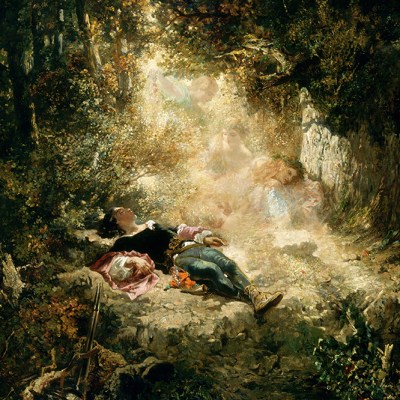
The work’s title, Seven Sleepers (2026), refers to the miracle of the Seven Sleepers of Ephesus: persecuted Christians who hide in a cave during the reign of one Roman emperor and wake up in that of another, some 200 years later, to find that Christianity is now the official religion of the empire. The myth, which dates from late Antiquity, has a parallel in the Qur’an, which tells of seven youths who refuse to worship more than one god, also take refuge in a cave, and wake up 300 years later to find that monotheism has triumphed.
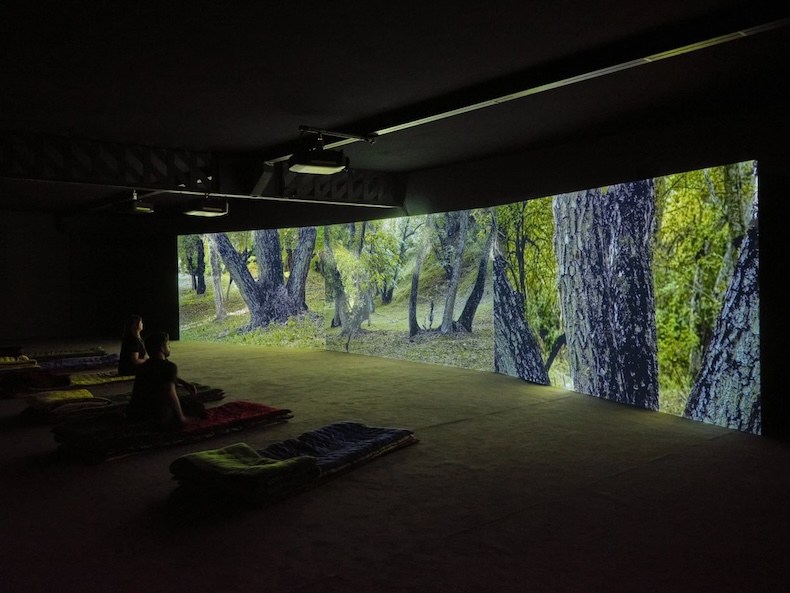
What kind of enchantment are Ismailova’s modern-day sleepers under? When the artist first visited Arslanbob she was fascinated to learn that ‘the forest consumes oxygen and the walnuts produce toxins’ – toxins that can have a hallucinogenic effect. If there’s something trippy about these sleepers’ dreams, they’re not telling, but their ease before the camera tells us something about the time Ismailova has taken to gain their trust. And ‘Amanat’ in the exhibition title comes from the Arabic word for ‘trust’, something held in care, a responsibility. As the artist puts it, ‘The way people inhabit the forest, it’s something that is impossible to direct.’ What we see on film, she says, is her ‘reaction to the place’.
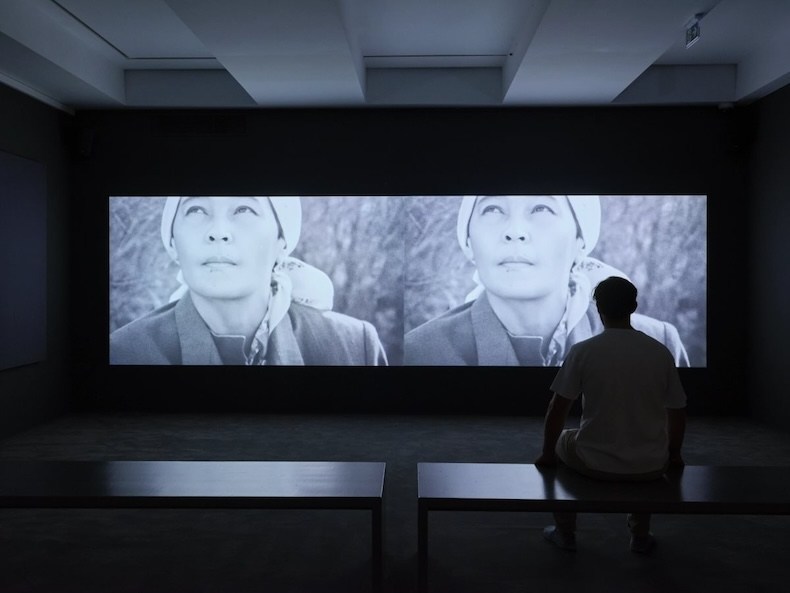
A different kind of spell is cast in Swan Lake (2025), a two-channel installation in which footage from films made by Central Asian directors, both during and after the Soviet period, play on both screens, interrupted at points by television broadcasts. The strangest and most notable of these are clips from the mass-hypnosis sessions conducted by the hypnotherapist Anatoly Kashpirovsky in 1989. Ismailova doesn’t dwell on the meaning of a man trying to hypnotise millions through the medium of television in the dying days of the USSR. She doesn’t need to. The title of the work reminds us that at moments of crisis in the Soviet Union – after the death of Brezhnev and subsequent general secretaries, for instance – state television screened the ballet while a new official line was being laid down.
Ismailova was born in 1981. ‘I was young when the Soviet Union collapsed, but it touched us,’ she says. It’s not surprising that an interest in ideology and how a sense of reality is formed runs through the artist’s work. More surprising, perhaps, is that she can wring so many effects from it, though ‘wring’ suggests a sense of effort that is absent from Ismailova’s wry and watchful art.
A parallel can be drawn, of course, between the altered states willed by a political regime (or arbitrarily created by the natural world) and the work of an artist. But Ismailova is making art, not propaganda, which contains possibilities she cannot intend or impose – even if she makes the ground rules. Of making films, she says, ‘When you start editing is the most exciting part. I always do the editing myself.’ However, in a film that uses archive footage as Swan Lake does, she’s not setting out to play god; the images have their own integrity. ‘You have a responsibility to them and it’s also important to use what’s there,’ she says.
The Letters, a project from 2014–19, conveys that sense of responsibility and offers a clue about where it comes from. A series of photographs of members of the artist’s family – a great-grandmother who taught Persian and Uzbek poetry in Turkistan in the late 19th century, a great-grandfather who was an Islamic theologian and spent 11 years in a Siberian camp, an illiterate grandmother who picked up some of the Latin, Cyrillic and Arabic alphabets, a mother who grew up in the post-war period and knew only Cyrillic – are laid over with poems and religious texts in the languages and scripts they used. At Arles the sequence ends with a photograph of the artist’s daughter, who is growing up in Paris, where Ismailova now lives. Here the overlaid French text is in the perfect cursive handwriting of the French school system. This is language, Ismailova seems to be saying, imposed by ideology or circumstance, and experienced as an enchantment or a spell over generations, if not – like the Seven Sleepers – for hundreds of years.
‘Amanat: The Sacred Forest’ by Saodat Ismailova is at Luma Arles until 10 January 2027.