From the July/August 2026 issue of Apollo.
The MAK, the Museum für angewandte Kunst (Museum for Applied Arts) in Vienna, was founded in 1863 by Emperor Franz Joseph I, just short of a decade after Prince Albert established the South London Museum – today’s V&A. It is possible to see these museums both as a flowering of princely European culture and as an attempt to bolster the quality of national design and the manufacturing industries. In the 21st century, when didacticism is frowned upon, these two museums are a riposte to the purer art galleries of their cities, institutions on the side of craft trying to improve the appreciation of the applied arts, and have them taken as seriously as pure art. In some ways, the ease with which a fashion exhibition such as ‘Chanel’ at the V&A can sell out – compared, say, to Yoko Ono at Tate Modern – suggests the inferiority complex might belong only to the practitioners of applied arts and not to the wider public.
An exhibition that recently opened at the MAK is trying to take on what is paradoxically the most overlooked and most expensive of the applied arts: jewellery design. On my trip to see ‘Glanzstücke’ (until 27 September), the guest curator Alexandrine Maviel-Sonet, director of patrimony and exhibitions at Van Cleef and Arpels, said that she hoped this exhibition would secure the work of jewellery designers as equal, in the minds of visitors, with the greatest artists elsewhere in the MAK collection. The exhibition is made up of about 300 pieces from the Van Cleef and Arpels collection and about 200 works held by the MAK. This points to a growing trend where luxury brands supply many of the loans to a museum show. The title of the exhibition means something like ‘showpieces’ or ‘gems’. The best of the best, in other words. By placing works from the Van Cleef & Arpels collection alongside those from the MAK collection, Van Cleef is hoping to establish a parity between the craftsmanship in both sets.
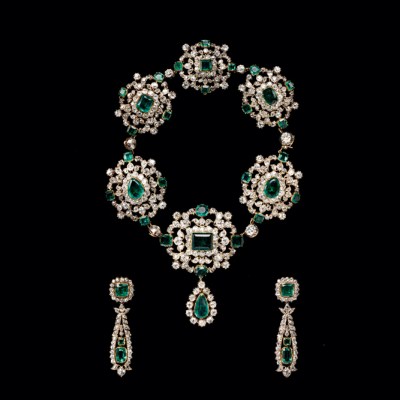
For a certain sort of person, looking at endless carats of sparkling diamonds is one of life’s simple pleasures. There are very few people who don’t get bedazzled by jewels, but asking people to look beyond the sparkle can be harder. The sheer volume of diamonds in a necklace such as that commissioned by Queen Nazli of Egypt in 1939 is stunning. A closer look reveals that part of the dazzle comes from the fact that so many cuts of diamond – pavé, emerald, baguette, round – are present on this single necklace. Technique amplifies beauty.
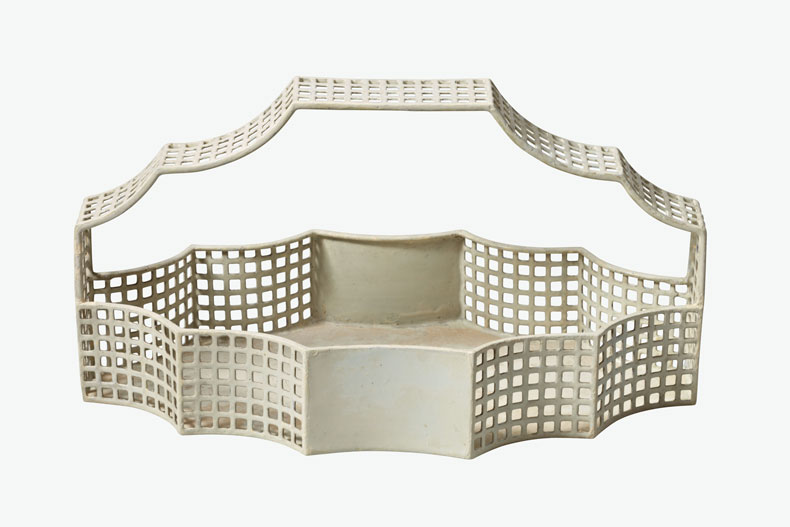
It can sometimes feel that the exhibition, as well as bringing out big hitters, is making a case for the commonality of European decorative taste in the 20th century. A basket by Josef Hoffmann from 1907 is perhaps one of the most beguiling items in the show. Made from perforated zinc and coated in white paint, it looks both delicate and strongly rigid, the square grid of the perforations playing with the curves of the basket’s structure. The curators have placed this next to another marvel of curved grids, Van Cleef & Arpels’s first Mystery set bracelet. Almost 30 years after Hoffmann, the Van Cleef workshop invented the technique of mounting square cut stones in grooves that created the illusion of an invisible setting; the bulging curve of bracelet’s sections echo the curves of Hoffmann’s basket. Together the objects seem to establish a taxonomy of modern good taste.
For all the noble intent of such an exhibition, part of the pleasure comes in the associations that only objects such as jewellery can conjure. Star power is as much a factor as skill in what people enjoy, and nowhere is this more apparent than in a five-leaf diamond and ruby brooch which comes with the added allure of having been owned by Maria Callas. It might not sing on its own but the brooch is now an object of worship. A perfectly chic ruby-and-diamond bracelet that was owned by Marlene Dietrich made its own screen appearance in both A Foreign Affair (1948) and Stage Fright (1950) and offers a reflection of star power.
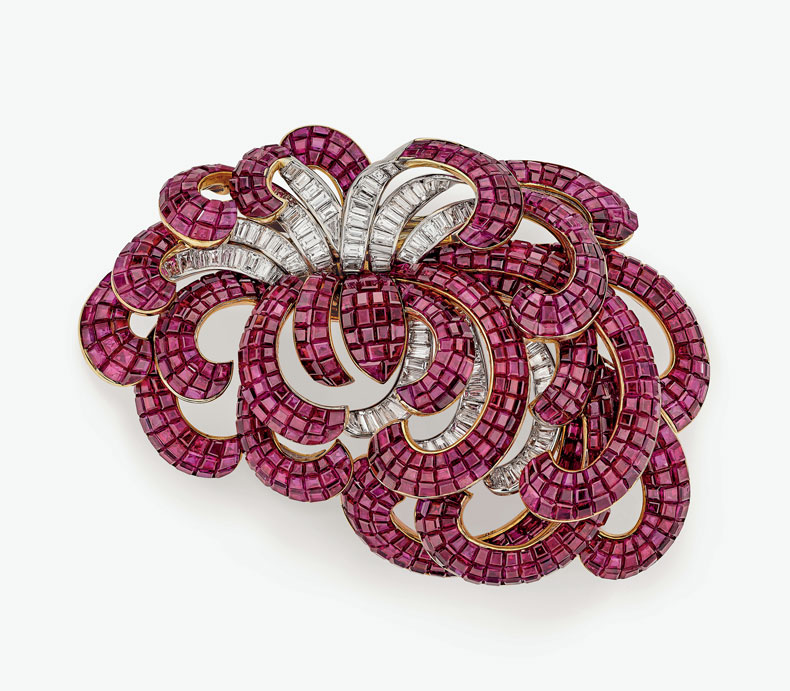
Fans of Van Cleef will recognise nature as a regular motif upon which their designers rely. Dealing in prettiness makes it a natural subject for the house – as well as for the designers of the Wiener Werkstätte, as can be seen in the fabric designed by Dagobert Peche for his wife in 1914. Reducing the complexity of natural form to legible abstract pattern is the province of both jeweller and textile designer. Both are trying to make a thing of beauty. A ruby peony brooch might take your breath away more easily but the process behind both forms is the same. Whereas Peche achieves his effect through nothing but line and colour, Van Cleef & Arpels seems to be attempting to emulate the divine with its recreation of nature using one of the largest expanses of Mystery setting it has ever produced.
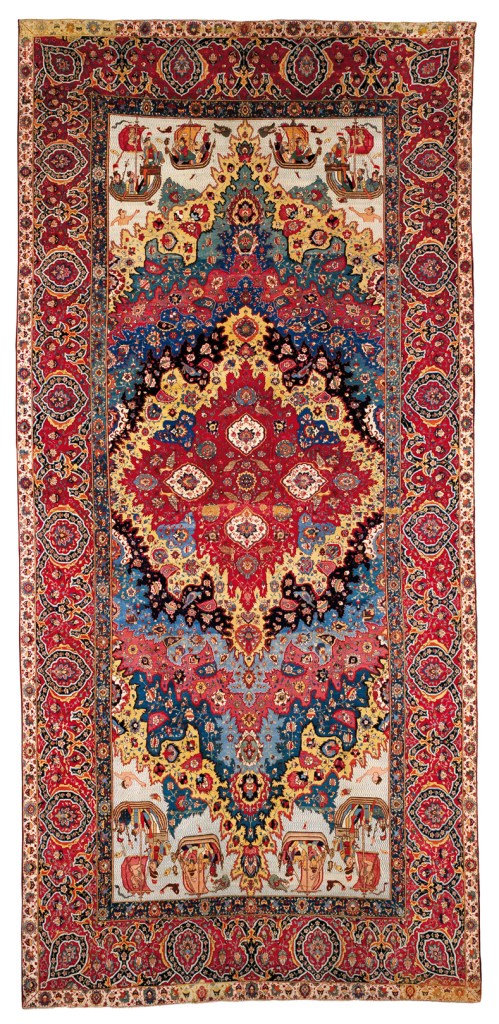
Many of the magnificent objects that are on show do not normally emerge from the MAK’s storehouse; conservation concerns keep them sheltered away from damaging light. The brevity of this exhibition means that the conservators have allowed them out. One of these is a ‘Portuguese carpet’, in fact from Khorasan, made in the 17th century. The tightness of the pattern and the use of colour is exceptional, but most intriguing is the depiction of the ship-laden sea at either end of the carpet. Swimming in the sea at one end are white Europeans, their entire eye sockets filled with a searing blue – a sign of their otherness.
Perhaps my favourite piece in the entire exhibition is not something ancient, or from far afield, but a Rhenish ball gown. A plain dress with puff sleeves and a wide, round neckline is transformed into something else entirely by a deep border of silver embroidery around the bottom of the skirt. Flowers and leaves, inexpressively fine in their craftsmanship, stand out from the skirt, the filigree of silk summoning the real-life delicacy of their natural counterparts. The dreams and the aspirations of the wearer are caught in each stitch. It is too delicate to be displayed for long periods and yet in its tender silver petals is the evidence that imagination and skill are the best of being human. While the curators might be trying to foster a dialogue between separate applied arts across the centuries, sometimes seeing a truly great object on its own terms is more than enough to convince you of why it matters.
‘GLANZSTÜCKE: Van Cleef & Arpels High Jewelry × Masterpieces from the MAK Collection’ is at the MAK, Vienna, until 27 September.
From the July/August 2026 issue of Apollo.