‘I spy a shovel, a long silver chain, a little toy horse, a track for a train. A birthday candle, a pretty gold ring, a small puzzle piece and a crown for a king.’ When we speak over Zoom in June, Walter Wick grins as he reads me a riddle. The American photographer is in Venice but he still has a copy of one of his hugely popular I Spy books to hand – helpful at times that call for a quick recital. Illustrated with Wick’s mind-bogglingly detailed photographs of his own miniature sets and optical illusions and accompanied by rhymes by Jean Marzollo, the series has become a classic of children’s search-and-find books. Some 30 years on, those photographs – and the models they were based on – are at the heart of a survey of Wick’s work at the High Museum of Art in Atlanta, peeled from the pages and displayed in full detail.
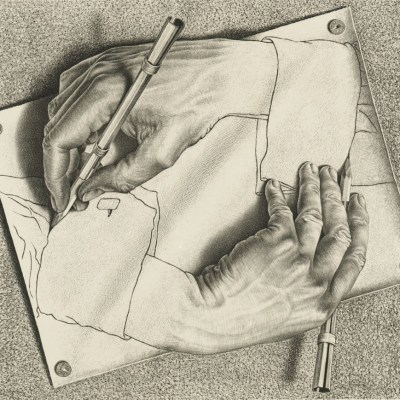
Wick, now in his seventies, has always loved a trick. He recalls picking up a pencil to copy an optical illusion he’d seen on the cover of MAD magazine at the age of eight or nine: ‘I was fascinated and copied it over and over.’ Childhood whims waned as he studied photography at Paier College of Art in Bridgeport, Connecticut – not far from his home town of Hartford – but those old illusions soon wiggled their way in. A photograph Wick took of a football goal perfectly mirrored in a pool of water, he says, prompted an epiphany: ‘It sunk in that photography wasn’t just about the external world but also what’s happening in your mind, how you perceive an image.’

Working as a commercial photographer in New York after graduating, he snapped up whatever commissions he could but hit his stride after coming across Games magazine on a news-stand in 1979. He’d played around with photographing puzzles before and decided to send in a photograph of a ‘mirror maze’ image, in which mirrors multiplied the toys placed in front of them. The response, he says, was surprising. ‘Not only did they like it, but they bought it right out from underneath me.’ Wick was asked to pitch more ideas, beginning a ten-year relationship with the magazine. Then he got a call from Marzollo – a well-established children’s author – for a new project, and I Spy: A Book of Picture Riddles was on the shelves by 1992. The unlucky few who haven’t read Wick’s books may be familiar with the last commercial work he produced later that year: the cover for the Cocteau Twins’ Four-Calendar Café – Robin Guthrie’s then five-year-old daughter, he tells me, was a fan of the book.
Looking at Wick’s images for I Spy, it’s hard to know where to set your eyes first, or to imagine how such intricate images were created in the first place. Each image is crammed with objects – trinkets, toys, knick-knacks – set against a plain background or, better yet, nestled into a mystical miniature scene. Some took weeks to set up, with teams brought in to create models of entire towns. But in the early days Wick often worked alone, painstakingly testing materials and lighting to produce an image that bore little evidence that what you were seeing was handmade. Clouds, from I Spy: Fantasy (1994), shows a busy twilight sky dotted with puffy clouds: in reality they’re wads of cotton pillow stuffing and ceramic figurines suspended with armature wire, with colour gels cast on to Plexiglas backgrounds to create the effect of a setting sun.

Another scene appearing in that edition was a favourite of Wick’s – set under the sea, magnets and jewellery charms became schools of fish; a toy figure of a ballerina was transformed with a tail. As a child I was baffled by how real it looked, with dappled light streaming on to the sandy floor. Wick breaks the illusion: it was all the trick of a light, shone on to rippling mylar – ‘There was no water used at all.’ Back then, he shot on 8×10 film, a large format, and is proud that no retouching was used to make the images more convincing – especially with the current prevalence of digital manipulation to smooth things out or to fake them entirely. He didn’t mind when things looked a little hand-built; in fact, that was often what won kids over. The sets weren’t meant to reflect ‘what it looks like to your parents, but what you see when you’re playing with these things and imagining your own world’.
What others might see as trash became treasure as Wick ‘ran the gamut’ of random materials to create images for the series’ eight original editions. ‘When you have a job like mine, every store becomes a potential [place to find] things to use.’ Naturally, a chicken-or-egg question comes up: did the pictures come first, or the riddles? ‘Jean had started on a bunch of riddles before we began, but I couldn’t use any of them – it was impossible to be inspired to make a picture based on something already written.’ They decided that Wick would start things off, hiding the objects in the photographs and sending a test shot on a Polaroid to Marzollo so she could begin writing, making little changes along the way before the final shot was taken.
Britain Museum of American Art. © 2021 Walter Wick.
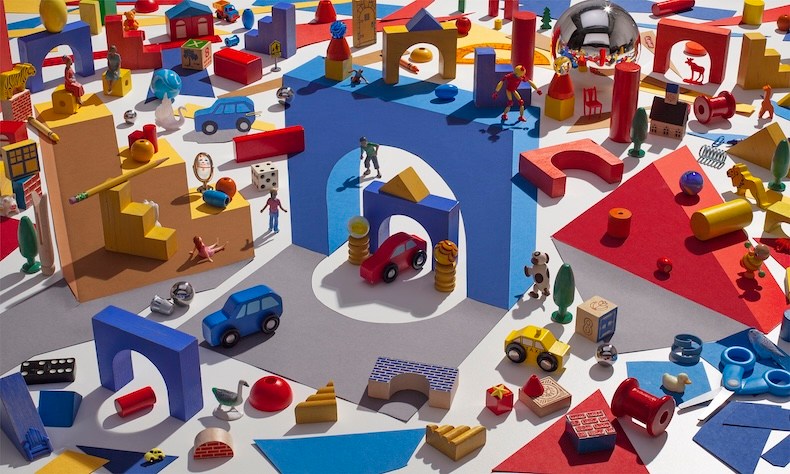
Marzollo and Wick produced their final I Spy book together in 2000 and, in 2002, Wick released the first book of a new search-and-find series, Can You See What I See? Here he played with anamorphic images, in which something appears distorted unless viewed from a specific angle. It’s an old ploy: think of Holbein’s The Ambassadors, Wick says. ‘If you took the canvas off the wall, put it on the floor and stood in the right position, that stretched-out skull would be corrected. What I tried to do is correct the image by using the viewpoint of the camera.’ Nowhere is this more apparent than in Flatland, from Hidden Wonders (2021). Here, Wick printed distorted images of building blocks, placing the original pieces on top. At first, the image stumps you when you try to make out what’s flat and what’s three-dimensional. You can logically resolve it, Wick says, but it’s a loop: ‘The mind always falls back into the illusions. That’s what I love, that it occupies this kind of uncanny valley.’
Wick has scaled down his operation since I Spy was at its peak – ‘I’m an artist, not an empire builder!’ Now living in Miami, he’s gone ‘back to [his] roots’ and is working on more books – some of them back in the I Spy world, written by Marzollo’s children, David and Daniel Marzollo, who took up the riddle-writing mantle after their mother’s death in 2018. Wick is not entirely sure what lies ahead – other than the need to take his dog for a walk after we wrap up the interview – but it’s bound to be good; he’s certainly not one to miss a trick.
‘I Spy! Walter Wick’s Hidden Wonders’ is at the High Museum of Art, Atlanta, from 28 August until 3 January 2027.