‘Watch out, wet paint!’ says Yves Goldstein cheerfully as he steps over a strip of yellow tape barring access to a freshly painted staircase. Goldstein is the managing director of new Brussels cultural centre Kanal and seems delightfully unperturbed that only four days before its opening on 28 November, it is still a work in progress. Builders in hi-vis vets and hard hats are working throughout the immense building, which resounds with the clanging of metal, and the information desk at the entrance is still a jumble of shelving and furniture yet to be installed. But this will soon no longer be Goldstein’s problem – he will step down the day after the museum’s opening weekend.
Goldstein’s exit is the culmination of his long battle against the regional Brussels government in a dispute over funding and the project’s future. He was already planning on leaving the role after a decade of work bringing his vision to life, but his departure was brought forward amid an atmosphere of thinly veiled tension between him and the new minister-president of the Brussels-Capital Region, Boris Dilliès, who was sworn in in February this year.
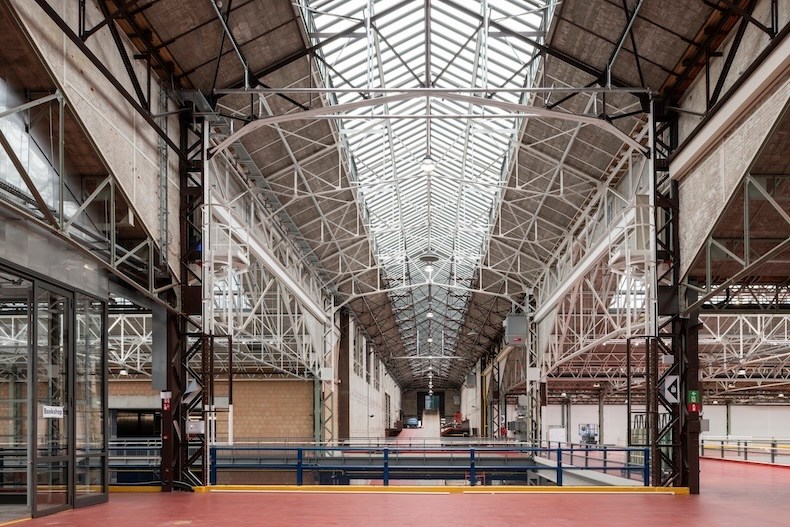
Around €230m has been poured into the project, which has taken 13 years to open its doors. Kanal is the Belgian capital’s first modern and contemporary art museum, located in a converted former Citroën factory that was conceived as a ‘cathedral to cars’ when it was built in 1934. And the 40,000 sqm space does have something of the vastness and splendour of a cathedral, with a high, pitched glass roof, steel beams and long, shallow ramps that remind the visitor of its industrial heritage.
An international architectural consortium made up of noAarchitecten, EM2N and Sergison Bates architects, titled Atelier Kanal, won the competition in 2018 to transform it into a creative hub. Around a third of the site is devoted to art exhibitions, while half is public space that can be used by anyone – a sort of external living room for Brussels residents and visitors. The Kanal team is brimming with analogies for the site: it’s a museum-refuge, a museum-mirror, a city-within-a-city. It has a bakery, bookshop and library, as well as auditoriums for film screenings and performances, two different restaurants and a rooftop bar.
‘If I were to use references from the Paris cultural scene, my dream is for it to be like the 104, the Centre Pompidou and the Palais de Tokyo rolled into one: a multidisciplinary space where people come not only to see art, but to make art,’ Goldstein says. In the children’s play area – the city’s only free indoor playground – designed by the Turner Prize-winning design and architecture agency Assemble, he nimbly leaps up on to a small mound made out of poured-in-place black rubber and gesticulates at the floor-to-ceiling windows.
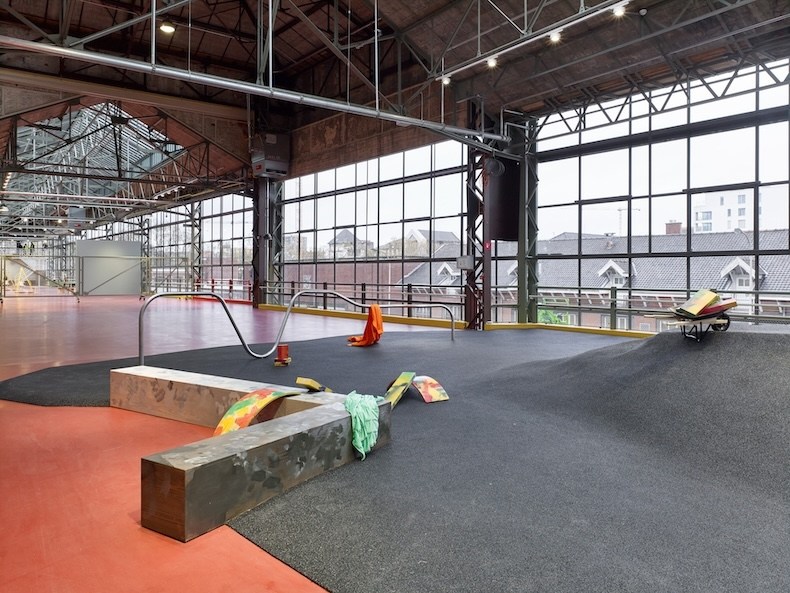
‘All of the window frames are the original ones from the 1930s, restored,’ Goldstein explains. ‘That was a wish of mine, to keep as much as we could of the modern industrial architecture. Not only because it’s beautiful, not only because demolition is not sustainable nowadays, but also because the richness of the building is its transparency. You really feel part of the city; you have contact with the city on all sides.’
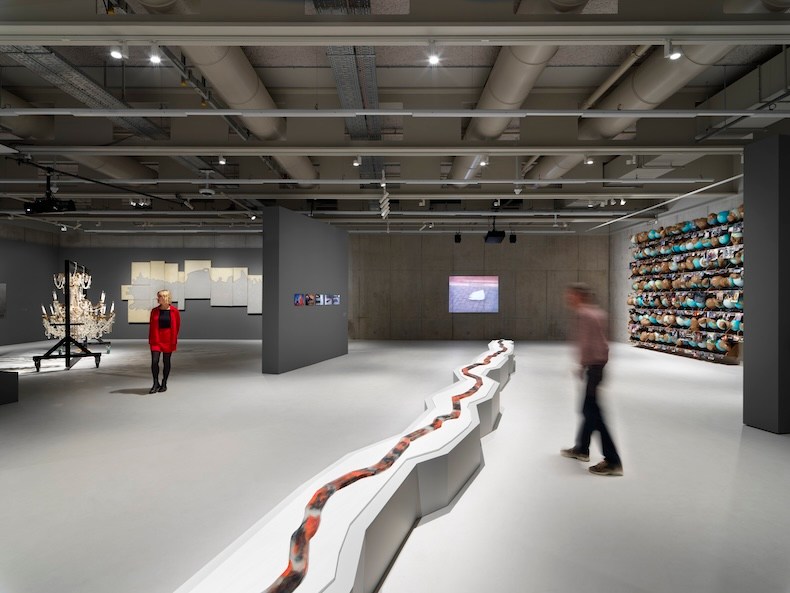
Kanal’s exhibition programme opens with ‘A truly immense journey’, a sweeping show of more than 350 artworks over three floors that includes work from the Centre Pompidou’s collections as well as work from Brussels-based artists. Alberto Giacometti’s Walking Man I is displayed alongside Otobong Nkanga’s Veins Aligned [with] A Lapse, a Stain, a Fall, a glass and marble sculpture that snakes through the first room like a river. Nkanga’s piece is one of the works that has been acquired for the museum’s nascent collection. A partnership with the Centre Pompidou allowing Kanal to borrow artworks until 2031 has been criticised because of its steep price tag of €2m a year. In a speech at the museum’s preview event, Dilliès emphasised the need for Kanal to make its own way in the world. ‘The challenge will be to make this place live throughout the year, to bring in new audiences and build a financial model that’s based on diverse sources of funding: events, our own restaurants and businesses, and also partnerships with the private sector.’
The regional government has already imposed budget cuts on Kanal. An initial allocation of €35m a year has been reduced to €28m, forcing the site to be closed for two days a week. That funding will gradually be reduced even further, dropping to just €10 million in 2029 – a figure that Goldstein says is equivalent to the building’s operating costs, including maintenance, cleaning and security. He estimates that Kanal could generate €14m–€15m a year by itself, but it has just three years to secure its financial future.
Other opening exhibitions include the spectacular ‘NO SHOW’, where artist duo Deborah Bowmann, musician Maoupa Mazzocchetti and 20 Brussels-based artists create a hugely entertaining immersive experience combining art, light, sound and live performance, and ‘An infinite woman’, which explores how Citroën used the image of a Mangbetu woman from north-eastern Congo in an advertising campaign for an expedition across Africa in 1925, and how African artists have reclaimed this colonial imagery today. Kanal is also the new home of the CIVA Foundation, the city’s architecture museum that has been renamed Kanal Architecture. Its inaugural exhibition, ‘Right to the City – Right to the Future’, recounts the city’s surprising history of grassroots architectural practices.
For all its modernity, the museum could be accused of Luddism: no screens, no QR codes – only ‘paper, humans, mediators – people who come to you to explain the artworks’, Goldstein says. ‘My conviction is clear: AI is the enemy of artistic creation. This museum is a refuge for people who want to disconnect from technology in everyday life and reconnect to art and to people.’
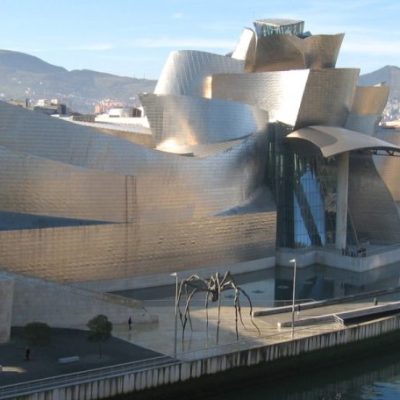
For the moment, Kanal is captainless, but its ambitions – and the stakes – couldn’t be higher. Both the city authorities and Kanal’s artistic management team are hoping for a Bilbao effect: that Kanal will transform its immediate neighbourhood as well as polish Brussels’ rather unglamorous reputation and turn the bureaucratic capital of Europe into one of its hottest art destinations.
Kanal in Brussels opens on 28 November.