The New Museum has reopened in a world that will soon be unrecognisable from the one in which it closed in 2024, if it isn’t already. The main reason for that is AI. As the only major museum devoted to contemporary art in New York, the New Museum clearly feels it necessary to ask artists how they think AI and other new technologies may change the world. The scope of the question matches the size of the new building (now twice as big as before) and is capacious enough to hold together, tentatively, all 700-odd works in ‘New Humans: Memories from the Future,’ an exhibition that is spread across all three floors, as well as the staircases, elevators and facade. Trekking through it all is a disorienting experience; the show is punctuated with a beat of excitement, rather than dread, about what this new chapter for humanity might hold.
‘New Humans’ starts with a gesture of reassurance from artists of the early 20th-century avant garde: this is not the first time machines have threatened to replace us. A reproduction of Duchamp’s painting The Bride (1912) shows how the artist reconfigured his subject into abstracted tubes, funnels, pumps and sheets that remind us of the contours of the human body but are more evocative of the guts of a factory. Hannah Höch’s collages cut up pictures of people for scrap parts and reassemble them: the top half of a head is taken from a baby, the bottom half from an old man; a long leg is borrowed from a ballerina, an arm from a Renaissance painting.
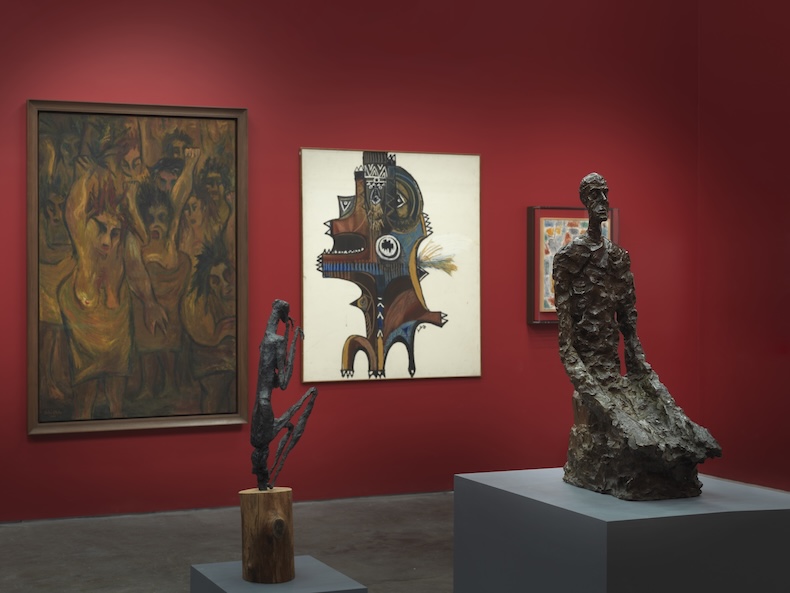
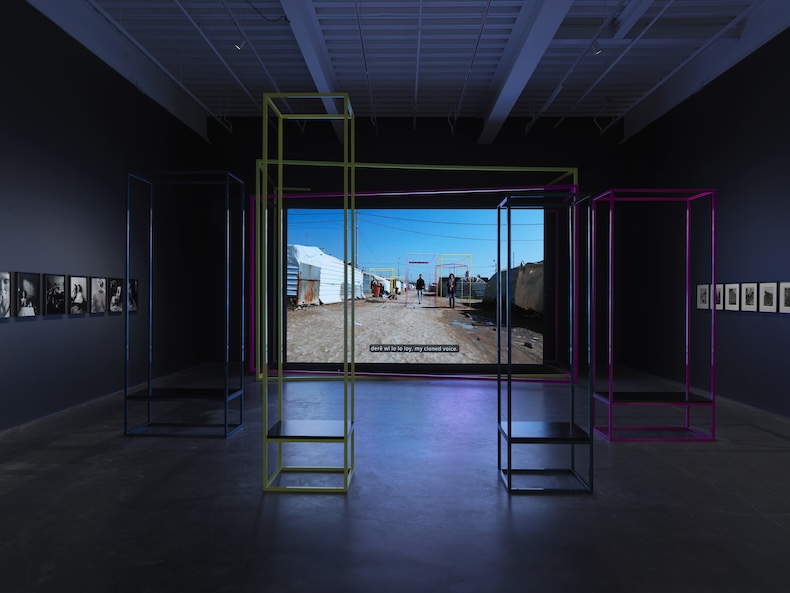
Yet, while modernists reduced humans and machines to essentially similar physical components, the contemporary artists in this exhibition uncover more subtle and unsettling resemblances. Daria Martin’s film Soft Materials (2004) portrays two nude performers gently playing with a mechanical sculpture, watching its gears turn like a child watches a butterfly, stroking a metal surface tenderly. Hito Steyerl’s video installation Mechanical Kurds (2025) shows us Kurdish workers categorising objects in images that have been taken by drones; their classification then trains AI as part of Amazon’s ‘Mechanical Turk’ programme, which allows you to outsource menial tasks to overseas labour. Steyerl explicitly compares this painstaking work for poverty wages with its namesake: the 18th-century automaton that could apparently beat anyone in chess until it was revealed that a human was secretly operating it from the inside.
As I advanced through the exhibition, the art became more extravagant and it was increasingly difficult to hold on to thread of measured historicism. Camille Henrot’s video In the Veins (2026) wants to show that ‘the natural environment and people are devalued in a capitalist consumer society where the appeal of the “new” reigns supreme,’ but in effect it does the opposite, stitching together mesmerising footage of nature with equally stunning images of technology and the ‘new’. The shuffling of feet through confetti in Times Square on New Year’s Day feels the same as the shuffling of feet through autumn leaves. Steam puffing from the pores of an iron is just as beautiful as droplets of rain racing down a window. Whatever Henrot’s political intent, it is eclipsed by the visual pleasure in every shot, whether the content is natural or not.
The exhibition reaches its climax on the third floor in a ‘Hall of Robots’ that is as dazzling as it is nauseating. Look down and you’ll see a mechanical snake by Pamela Rosenkranz slithering across a bright pink carpet. Look up and a giant jellyfish sculpture by Anicka Yi flies overhead and across the galleries. Look anywhere else and there are dozens of televisions manically flickering between images of cartoons and workout videos, full of screeching bells and buzzes.
The ‘Hall’ feels like a realisation of the visions of Jules Verne and H.G. Wells, but without any of the disquiet those writers intended. Albert Robida’s drawing for his novel Le Vingtième Siècle 1883), hanging in the gallery next to that of the robots, feature magnificent inventions such as a tube to take travellers from Paris to Tangier or bat-like flying machines for military men to patrol the sky. And yet, the inhabitants of this world seem totally unfazed. One woman smiles as she steps off the edge of a balcony into the cab of a blimp. Another man puffs his cigar, contentedly watching a burlesque show in a magical spotlight. These drawings must have had a satirical bite in their time, but it is difficult to read them with any sentiment other than enthusiasm in the context of this bright and bubbly gallery.

‘New Humans’ provides hundreds of sketches of what the world may look like once technology changes what it means to be human, but displays no preference for any one vision in particular. The show feels like a carnival, leaving visitors to go on whatever rides take their fancy. This seems honest to me: no one knows whether we’ll end up in thrall to the robots or whether we’ll ascend into a techno-utopia – or if there is a third way. It will be a spectacle whatever happens, and the New Museum can provide you with a front-row seat.
‘New Humans: Memories of the Future’ is ongoing at the New Museum, New York.