From the June 2026 issue of Apollo.
As so often, if you were to believe social media, the obsession with how a table is ‘dressed’ is only a recent development. But as a cursory glance at any painting of a dining scene will show, this is far from the case. The role of meals in diplomacy is a well-worn trope. Dinner is not for eating but for hammering out the details of international relations, exchanging consorts to ensure alliances or cementing the state of diplomatic entente following a hard day’s work of negotiations. This is the position from which the president of the United States operates when he so graciously demands dinner at Buckingham Palace. If a table is going to be put to work as the stage for political relationships, then those most adept at using politics are going to ensure that every element of the table
displays power.
It was not until the 16th century that silver vessels made an appearance on the dining table. While this was partly a display of wealth, silver came with the additional pleasure of brightening the table due to its excellent ability to reflect light. Yet silver was not able to truly come into its own on the dining table until the way people ate changed. As meals evolved from having all the dishes placed on the table at once to eating courses one after the other (service à la russe), more space opened up to be exploited. Candelabra, vases and sugar sculptures all came to fill the vacuum left by the relative absence of food.
Bowls that had been placed under candelabra both to catch the wax and to reflect the light were replaced by the form of the surtout de table, a long flat sliver of silver that contains a mirror hidden by a decorative gallery around the edge. The first instance of such an object on the table predates the introduction of service à la russe by some 100 years. It appeared in 1692 at the wedding of the man who would become Philippe II, Duke of Orléans. Appropriately enough for an invention that centred on reflective glass, the banquet took place in the Hall of Mirrors at Versailles. The first surtout was a way of dressing the table to make it match the room, as well as a way of protecting the table from any abrasive condiments or sauces, such as salt and vinegar. But with the introduction of courses, the surtout de table became more common and expanded to be made not only from silver but also from gilded bronze.
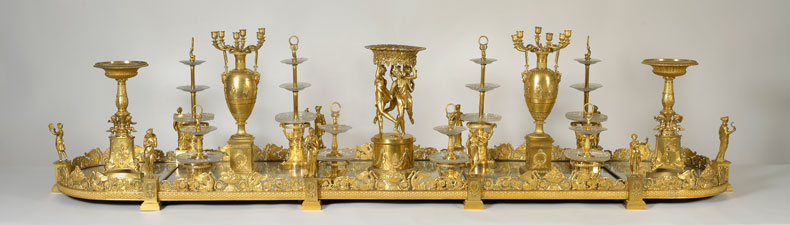
One of the most tantalising surtouts de table is now in the Cooper Hewitt in New York. The gilded bronze centrepiece was made by French bronzier Pierre-Philippe Thomire around 1810 and was said by the donor to the museum to have been given by Napoleon to his stepson Eugène de Beauharnais. The three graces at the centre of the work, and the martial and the classical garlands around the edge, align with the decorative elements common to Napoleon’s self-styling after he became Emperor of France.
It looks positively modest next to the surtout de table in the Spanish Royal Collection. This gilded-bronze centrepiece was made by the Roman goldsmith Luigi Valadier in around 1778 for the Knights of Malta’s ambassador to the Holy See. It contained not only gilded bronze but precious stones and enamel in the form of reduced Roman temples designed to allude to buildings such as the Arch of Septimus Severus in Rome and the Arch of Trajan in Ancona. In 1786, the Spanish ambassador in Paris, the Count of Aranda, bought the work for Don Carlos, soon to be Charles IV, who had long held a fascination with hard stones and mosaics. (One of the most fascinating objects in the Galleries of the Royal Collections in Madrid is the chest that contains an example of every hardstone to be found in the entirety of the Spanish Empire.)
Under the aegis of the Royal Laboratory for Mosaics and Hardstones of Buen Retiro, Juan Bautista Ferroni and Luigi Poggetti enlarged the base and added further architectural details. Perhaps that is the real act of political power: transforming icons of one of the greatest empires in the world into nothing more than table decorations. The material might not be silver, but it ends up reflecting a more illuminating light than the craftsmen who designed it could have imagined.
From the June 2026 issue of Apollo.