From the December 2026 issue of Apollo.
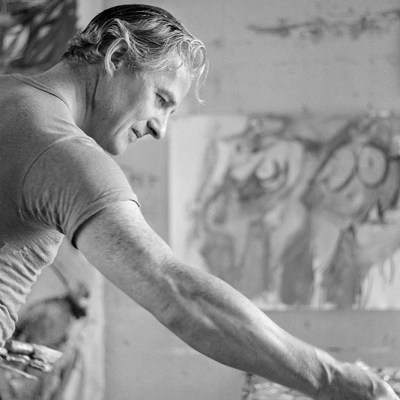
In July 1926, at the age of 22, Willem de Kooning left Rotterdam for New York, a stowaway in the engine room of a British cargo ship. Speaking no English but excited to enter what he saw as a land of abundance and possibility, he stayed, became an American citizen in 1962, perfected and undid and redrew the purportedly American aesthetic of Abstract Expressionism, and died at home in East Hampton in 1997. His centenary-of-departure has already been celebrated in his adopted homeland, via the Art Institute of Chicago’s ‘Willem de Kooning Drawing’. Opening a few weeks after that show closed, the Rijksmuseum’s ‘Willem de Kooning at Work’ is a slimmed-down version, augmented by fewer paintings and sculptures though nevertheless featuring more than 120 works, and still the largest de Kooning show in Europe since 1984. Mounted in the country he spurned, it’s a bittersweet act of reclamation and reinscribing, not least where, in an adjunct to the exhibition proper, the curators nestle two of de Kooning’s 1950s Women paintings in the Gallery of Honour, directly opposite the Rembrandts. On his cloud he’s surely proud.
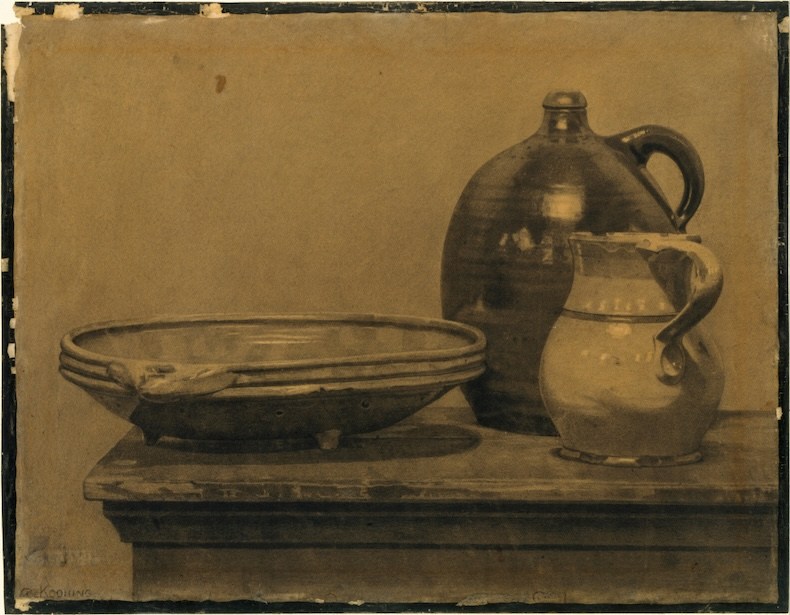
The show itself, divided across nine rooms, has its earliest inclusion in the first space – de Kooning’s very 17th-century Dutch still life Dish with Jugs (c. 1919–21), glimmering with light in gloom, made at Rotterdam’s art academy and the product of hundreds of hours of drawing. And the latest work is in the penultimate room – the air- and light-filled Untitled (1985), fine blue curves and contours dancing on a deceptively worked white field. But what lies in between isn’t strictly chronological, because de Kooning wasn’t. The curatorial bent, frequently detouring from the timeline with compare-and-contrast inclusions, emphasises how he doubled back and worried away at motifs and subjects over a lifetime, mostly the abstracted curves and contours of the human body. At one point, the show pairs the hard-pencilled observational drawing Study of a Man’s Arm (1927–39) with a formally similar but rough-hewn sketch of an arm or leg from c. 1964, as if the artist who could spend six months on a shoulder were still dissatisfied. By the time you reach that painting from 1985, you’re primed to glimpse – a very de Kooning word – idealised, impossibly elegant echoes of limbs, clavicles, curving necks flickering everywhere in it, because you’ve seen so many already.
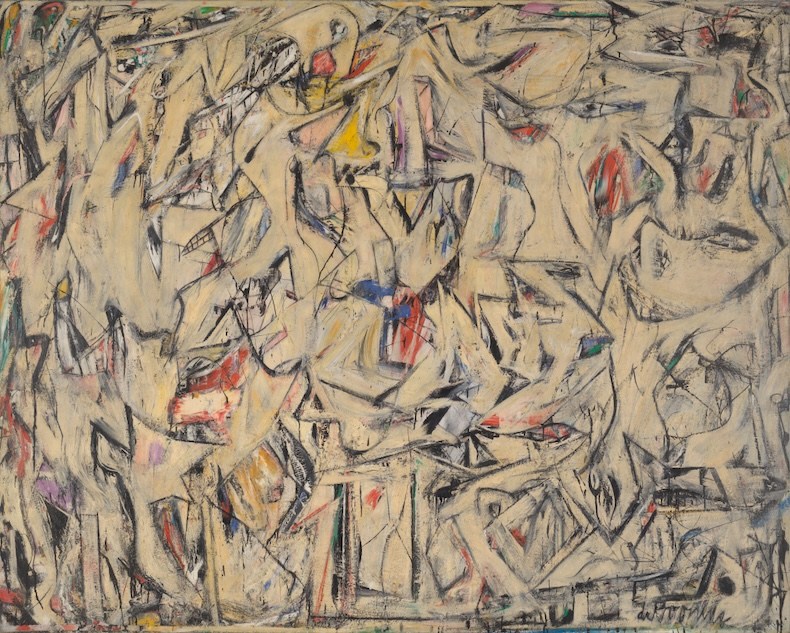
These recursions aside, the exhibition does broadly roll forwards in time. One early room accelerates through de Kooning’s two-decade commercial apprenticeship period in New York as a designer of stage sets and window displays, magazine illustrator and maker of murals for the New Deal initiative the Works Progress Administration, whose blocky abstract structures soon tinctured his own drawings and paintings. Here, ringed by related works on paper, we get early-masterpiece canvases such as Pink Angels (c. 1945), with its Picasso-indebted, high-velocity violence between phallic seraphs; the dark cave, striated with allusive white lines, of the near-abstraction Untitled from 1948–49 (though there’s a graffiti-like penis in there too); and its tonal opposite, Excavation (1950), a synthesis of all-over abstraction and countless hints of mouths, eyes and heads squashed together on a butter-coloured base, set in swarming motion by de Kooning’s use of smudgy, labile charcoal and winking with flashes of colour. The bits of faces can look cartoonish – de Kooning was a fan of Krazy Kat and probably Bugs Bunny – but his line, honed by his academic training, is ferociously agile and sophisticated.
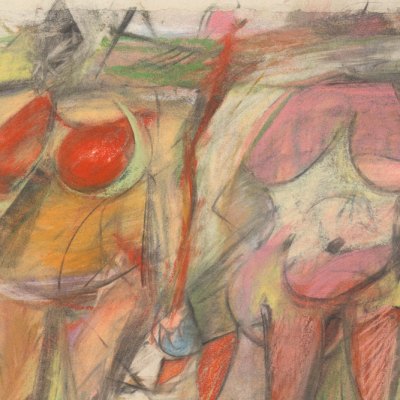
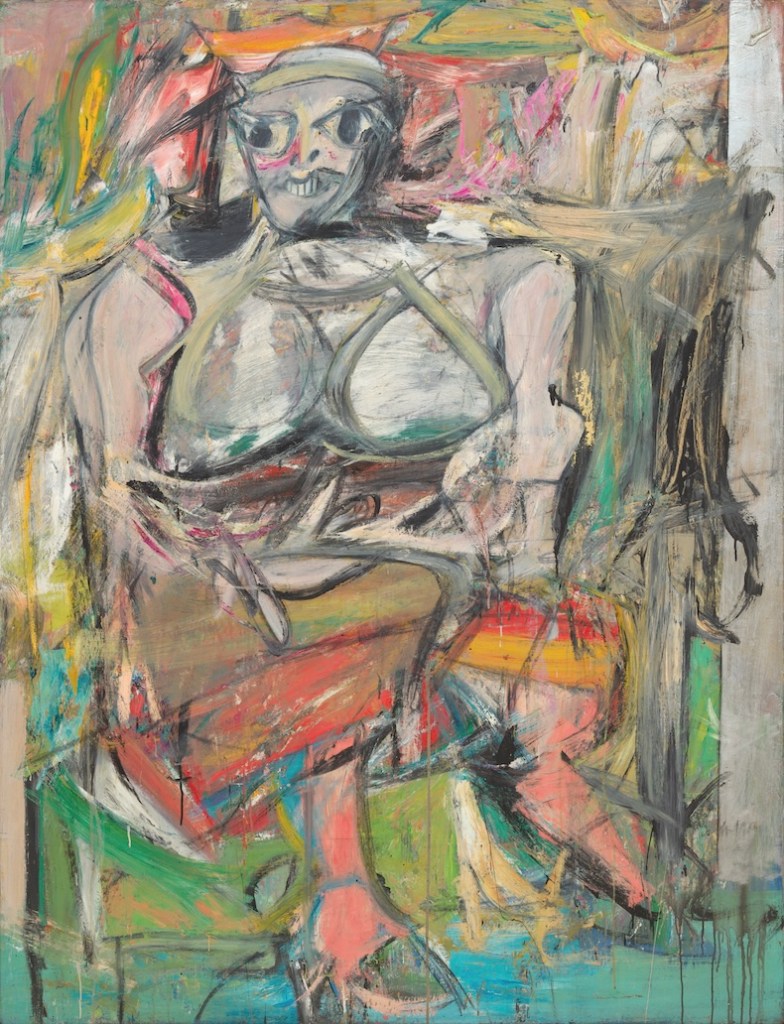
By this point, having established himself as a master abstractionist – though one might easily argue that he was always a figurative painter of sorts – de Kooning was already making the run-up, on paper, to the Women that would be seen by many as a betrayal of the abstract cause. The show lingers satisfyingly on this era. Myriad speedy, colourful drawings from the late ’40s to the early ’50s locate the imposing and hieratic female figures’ roots in Picasso’s Les Demoiselles d’Avignon (1907) and de Kooning’s attention to Marilyn Monroe, and emphasise the structural slippages of de Kooning’s figuration. (It’s clearer in the drawings how the women’s midsections often function as second, larger heads.) Meanwhile, the curators generously diffuse any macho implications in the work. A wall text serves up a head-turning quote: ‘Many of my paintings of women are self-portraits. I never thought about which sex they would belong to,’ and, in the Gallery of Honour, Woman I (1950–52) and Woman and Bicycle (1952–53) are hung high, towering like antic sentinels over the viewer.
After a brief glimpse into de Kooning’s one substantial return to Europe – a sojourn in Rome in 1959–60, which birthed black-and-white abstractions reminiscent of his old friend Franz Kline – the show pivots to his seclusion in Springs, East Hampton, in the ’60s and ’70s. Out here the shimmer of light on water inflected his figuration (cue quivery, shaky drawings of figures) and forays into black bronze sculpture whose ridged, uncertain contours find liquidity in the most solid of formats. (That de Kooning continually collapsed the difference between drawing and other, more substantial art forms is a sub-theme of the show.) A suite of 1960s charcoal drawings made with eyes closed – or maybe not, but that’s the rumour their maker put about – advertises de Kooning’s restlessness; they also suggest crucifixions.
A traditional retrospective, which this is not, would probably have moved towards a close by cherry-picking the late abstractions, which were haloed in controversy as de Kooning evidently continued to paint while sliding into the fog of Alzheimer’s. Instead, the exhibition circles back to the drawings, his wellspring, and then pointedly fudges the line between minor and major work. A big charcoal drawing on semi-translucent vellum, Woman (1983), finds the artist engaged once again with his most salient motif, the figure emerging from or fading into an improvised system of aerodynamic curves. Other sizeable vellum drawings are displayed in suspended backless frames, viewable from recto or verso, as if to summarise how nothing in de Kooning’s practice was ever finished or definitive, just a way station before the next related thing. Then finally there were no next things. But what he left, as this spectacular yet intimate show makes clear, is still surpassingly alive.
‘Willem de Kooning at work’ is at the Rijksmuseum, Amsterdam until 17 January 2027.
From the December 2026 issue of Apollo.